
The app for fair co-parenting

About two fair parents and their app

twofair is a straightforward app for CO-PARENTING that brings financial fairness to children’s cost.
Parents use twofair to find a clear, uncomplicated way to split child-related expenses fairly. The app has helped ease emotionally difficult situations and rebuild trust between parents, so the focus can return to what matters: the child’s wellbeing.
Everything you need to know about twofair
From adding your first expense to how much twofair actually takes care of for you — here are the answers to the questions we hear most often.
How twofair came to be
twofair wasn’t designed on a drawing board — it grew out of a real separation. Two kids, a nesting arrangement: the kids stay in the shared home, the parents take turns moving in and out. That sounds like a good solution for the kids — and it is. But there’s one thing it doesn’t solve on its own: who pays for what.
Clothes, shoes, a doctor’s visit, school supplies — each expense small on its own, but adding up fast. It was never just about doing the math. It was about the feeling of having to keep track of everything, while everything else in life was being rearranged at the same time.
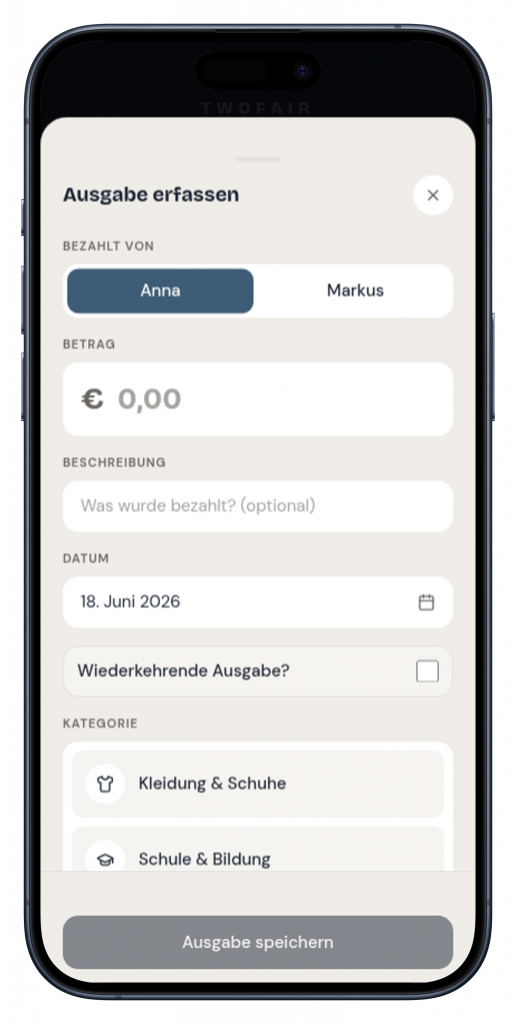
The first attempt was a shared spreadsheet — the simplest solution on paper, a disaster in practice. The next step seemed obvious: build something myself, with the help of AI tools. That worked up to a point, but it wasn’t particularly secure, and it wasn’t actually cheap either, once you count your own time honestly.
What made the difference in the end was timing: modern AI-assisted development made something possible that would have taken a whole team just a few years ago — that’s why twofair exists now, not sooner. And the more we talked with other parents in similar situations, the clearer it became: this isn’t a one-off case, it’s a quiet, rarely-discussed problem. That’s where the thinking behind twofair comes from — a tool for a situation nobody chooses: deliberately kept lean, deliberately affordable, without expensive marketing that users would end up paying for anyway.